


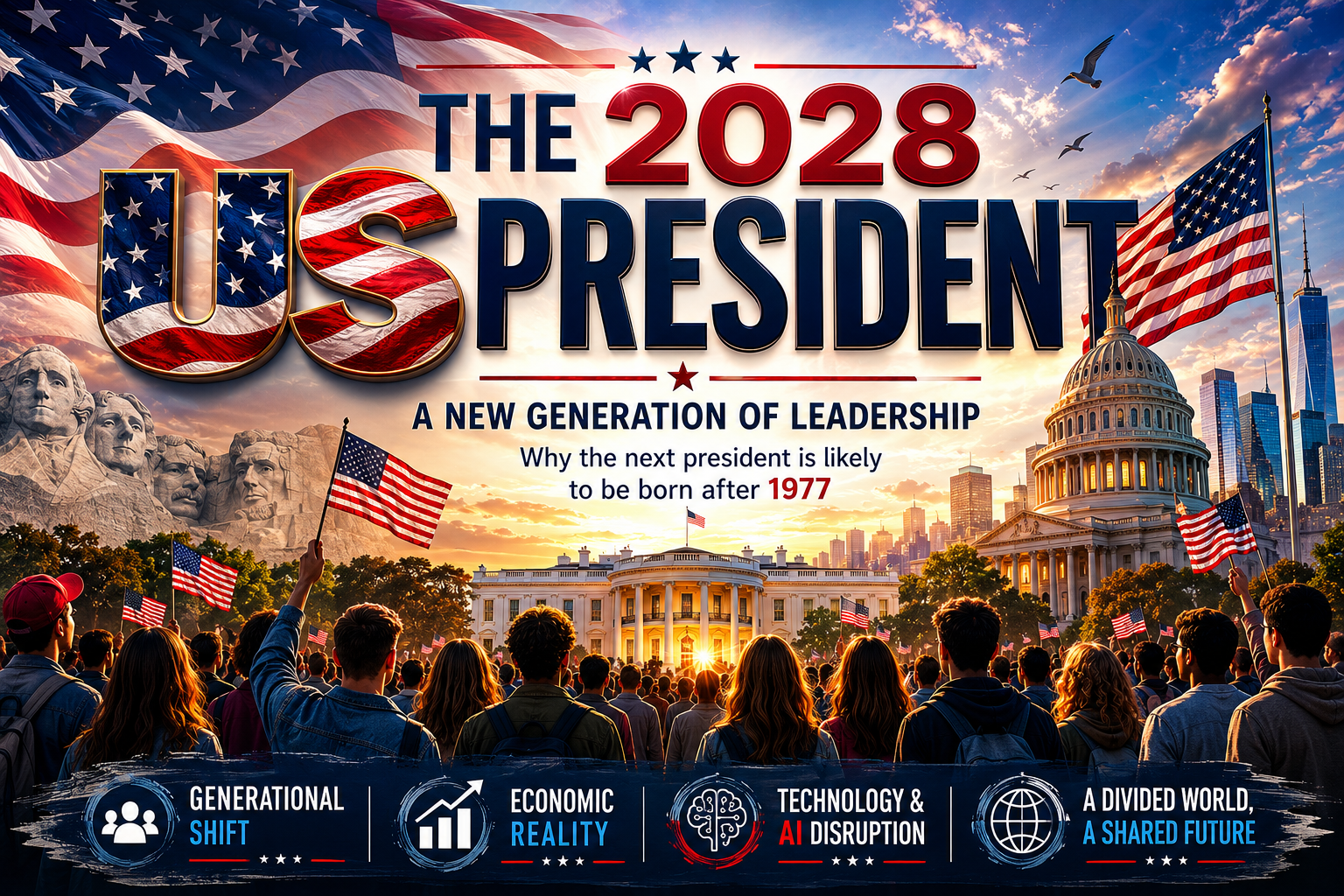
Forget personalities. The generational math of 2028 is already taking shape.
Political leadership in the United States does n’t pass cleanly from one generation to the next. The familiar story—Boomers to Gen X, Gen X to Millennials, Millennials to Gen Z—sounds orderly, but history tells a different story.
Power does not move sequentially. It jumps when voter math, economic pressure, and timing align.
My thesis is simple:
The next president is likely to be born after 1977—either a late Gen Xer or a Millennial—because that cohort sits at the intersection of Gen Z’s economic anxieties and the economic power still held by Gen X and Baby Boomers.
This is less about ideology and more about demographics. Less about candidates and more about generations.
A note on generations: For consistency, this analysis uses Pew Research Center’s modern generational definitions—Baby Boomers (1946–1964), Generation X (1965–1980), Millennials (1981–1996), and Generation Z (1997–2012). For earlier historical cohorts before 1901, it uses the widely recognized Strauss–Howe generational framework.
Presidents by Generation
| Generation | Birth Years | Presidents |
| Progressive | 1843–1859 | McKinley, Theodore Roosevelt, Taft, Wilson |
| Missionary | 1860–1882 | Harding, Coolidge, Hoover, FDR |
| Lost | 1883–1900 | Truman, Eisenhower |
| Greatest | 1901–1927 | JFK, LBJ, Nixon, Ford, Reagan, Carter, George H.W. Bush |
| Silent | 1928–1945 | Biden |
| Boomers | 1946–1964 | Clinton, George W. Bush, Obama, Trump |
| Gen X | 1965–1980 | None |
| Millennials | 1981–1996 | None |
The most striking fact in modern presidential history is that Gen X has not produced a president.
Is Gen X Becoming the New Silent Generation?
The strongest historical analogy for Gen X may be the Silent Generation.
The Silent Generation was born between 1928 and 1945 and was sandwiched between two much larger cohorts: the Greatest Generation and the Baby Boomers. It produced accomplished leaders, governors, senators, military officers, and presidential nominees.
Yet it produced only one president: Joe Biden.
Consider the roster:
- Michael Dukakis
- John Kerry
- John McCain
- Ross Perot
- Joe Biden
The Silent Generation was rich in contenders but poor in presidents.
Gen X increasingly looks similar.
Like the Silent Generation, Gen X sits between two larger generations. Boomers dominated politics for decades. Millennials represent the next major demographic wave.
Both generations developed reputations for pragmatism rather than idealism, management rather than movements, and institutional competence rather than transformational politics.
Today’s core Gen X bench is impressive:
- JB Pritzker (1965)
- Gavin Newsom (1967)
- Cory Booker (1969)
- Ted Cruz (1970)
- Marco Rubio (1971)
- Gretchen Whitmer (1971)
- Nikki Haley (1972)
- Josh Shapiro (1973)
Yet none has broken through to the presidency.
What Actually Happened in 2008
Millennials represented only about 17–18% of voters. They were not the largest voting bloc.
Yet they became decisive.
They turned out. They voted cohesively. They provided the margin of victory in critical swing states.
Barack Obama was technically a late Baby Boomer (1961 born), but politically he felt like the future.
His opposition to the Iraq War gave him credibility with younger voters who viewed the conflict as a defining policy failure. His campaign mastered digital organizing before most campaigns understood its importance. His message resonated with a generation entering adulthood during the worst financial crisis since the Great Depression.
Millennials elevated the candidate who best captured their generational mood.
Why Gen Z Matters
Gen Z, defined by Pew as Americans born between 1997 and 2012, will comprise voters between 18 and 31 years old in 2028, placing the generation squarely in deciding-bloc territory.
The forces shaping this generation are clear:
- Housing affordability challenges due to high interest rates
- Student debt burdens
- Wage stagnation
- AI-driven disruption of entry-level careers
- Delayed wealth accumulation
But Gen Z is not one electorate.
It is several overlapping electorates.
Different Educational Paths
One of the biggest mistakes in political analysis is treating Gen Z as synonymous with college students.
Much of the media’s understanding of younger voters is shaped by what happens on college campuses. Yet roughly 60% of Gen Z voters are non-college voters, meaning they do not hold a four-year college degree.
That distinction matters because these groups often experience very different economic realities.
College-educated Gen Z voters are more likely to pursue professional careers and view economic and cultural issues through one lens. Non-college Gen Z voters are often entering the workforce earlier, navigating different pressures, and placing greater emphasis on wages, affordability, job security, and upward mobility.
Any successful 2028 candidate will need to bridge these perspectives rather than speak only to the most visible young voters.
Young Men and Young Women
The 2024 election revealed one of the most consequential trends in American politics: Gen Z is not moving in one ideological direction.
Young women voted at higher rates than young men and generally leaned toward Democratic candidates. Young men, meanwhile, showed a noticeable shift toward Republican candidates.
What makes this trend significant is not simply the partisan split. It is that the two groups are increasingly experiencing different social and economic realities.
Young women have made substantial gains in higher education and increasingly dominate many college campuses. Young men, by contrast, are expressing growing concerns about economic opportunity, career prospects, identity, and social belonging.
The result is a widening political gap within a single generation.
Candidates who speak only to the concerns of college-educated young women risk alienating a growing segment of young men. Candidates who focus exclusively on young men’s frustrations risk losing credibility with young women.
The winning coalition in 2028 will likely belong to the candidate who can address the economic anxieties of young men while maintaining the trust of young women—a balancing act that neither party has fully mastered.
Purpose, Faith, and Belonging
Beyond economics, many younger Americans are navigating deeper questions of identity, purpose, belonging, and community.
Young women are becoming less religiously affiliated at a faster rate than young men. Meanwhile, some young men appear to be maintaining—or in some cases renewing—connections to religious communities and traditional institutions.
Part of this trend is being reinforced through new media ecosystems. Influencers such as Charlie Kirk (Turning Point USA) and a broader network of podcasts, creators, and online communities have built large audiences among younger voters by discussing topics that traditional politics often overlooks: faith, family formation, marriage, masculinity, purpose, and community.
Whether one agrees with these messages or not, their popularity reflects a deeper reality. Many younger Americans are searching for meaning and belonging in an era when trust in institutions is declining and traditional milestones—homeownership, marriage, and starting a family—feel increasingly difficult to attain.
A growing body of research suggests that Gen Z is marrying later, dating less frequently, and reporting lower levels of sexual activity than previous generations at similar ages. At the same time, social media and digital communities increasingly shape how young people form relationships and construct identity.
This creates another paradox of modern life: younger Americans are more digitally connected than any generation in history, yet many report greater loneliness, isolation, and uncertainty about the future.
For some, the response is greater political activism. For others, it is a renewed interest in faith, family, local community, or personal purpose. Still others seek belonging through online communities and alternative media networks.
The candidate who understands these aspirations without reducing them to ideology will possess a significant advantage in 2028. The challenge is not simply winning votes. It is speaking to a generation that is searching for meaning, stability, and a sense of place in a rapidly changing world.
AI, Work, and the K-Shaped Economy
Many of the economic challenges facing Gen Z predate Artificial Intelligence. Rising housing costs, expensive higher education, student debt, inflation, and delayed wealth creation have been shaping the generation’s outlook for years.
There is also a growing debate about the return on investment of a college degree. Underemployment among recent college graduates has remained stubbornly high for decades, with roughly 40% working in jobs that do not require a four-year degree. As the cost of higher education continues to rise, many young Americans are questioning whether the traditional pathway from college to career remains as reliable as it once was.
Higher interest rates do more than increase the cost of buying a home. They also affect hiring. Small businesses account for 99.9% of all U.S. businesses and employ nearly 40% of the American workforce. Because smaller firms are often more sensitive to borrowing costs, they tend to become more cautious about expansion, investment, and hiring when interest rates remain elevated.
For younger workers trying to gain a foothold in the labor market, fewer opportunities at the margin can have lasting effects on career development.
AI enters this story not as the primary cause, but as an additional layer of uncertainty.
Many of the entry-level roles that traditionally served as stepping stones into professional careers are among those most likely to be reshaped by automation and AI-assisted work. Whether AI ultimately creates more opportunities than it eliminates remains an open question. What matters politically is that many younger workers perceive the ground shifting beneath them.
At the same time, the U.S. economy increasingly resembles a K-shaped economy. On one side are households that own homes, stocks, and other appreciating assets—groups disproportionately represented by Gen X and Baby Boomers. On the other are younger Americans struggling to enter the housing market, build wealth, and establish financial security.
This creates two very different economic experiences within the same economy.
Beyond economics, younger voters are also coming of age during a period of growing geopolitical uncertainty. Ongoing conflicts in Eastern Europe and the Middle East, rising tensions among major powers, and concerns about future military commitments contribute to a broader sense that the world is becoming less stable.
As with the Iraq War in 2008, foreign policy may become more politically salient if younger voters conclude that they will disproportionately bear the long-term costs of decisions made by older generations.
The picture is also more complicated than a simple young-versus-old divide. While many older Americans benefited from decades of asset appreciation, millions of retirees remain heavily dependent on Social Security and face growing concerns about healthcare costs, housing expenses, and retirement security. Longer life expectancy means many Americans must stretch savings further than previous generations ever anticipated.
The political challenge for 2028 is therefore not choosing between younger and older voters. It is finding policies that restore economic mobility for younger generations while preserving financial security for older Americans.
The winning candidate in 2028 will need to understand both worlds: the aspirations of younger voters seeking economic mobility and the concerns of older voters whose wealth and retirement security remain tied to asset appreciation and continued economic growth.
Why the Next President Is Likely to Be Born After 1977
The strongest position in 2028 may belong to a leadership cohort spanning late Gen Xers and Millennials—roughly those born after 1977. Just as Barack Obama represented the younger edge of the late Baby Boomer generation in 2008, many of today’s emerging contenders come from the younger edge of Generation X and the Millennial generation. They occupy a unique position between Gen Z’s economic anxieties and the economic power still held by older generations.
There is another factor that receives little attention.
Most Gen Z voters were raised by Gen X parents. Historically, generations rarely seek to replicate their parents’ leadership. They tend to gravitate toward leaders who feel adjacent to their experiences while still possessing enough maturity to govern.
That creates a challenge for the core Gen X establishment.
Newsom, Rubio, Haley, Whitmer, Shapiro, Booker, Cruz, and Pritzker represent the core Gen X political establishment. Whether voters view them as agents of renewal or continuity may become one of the defining questions of 2028.
Meanwhile, the emerging presidential bench is clustered between 1977 and 1989.
| Candidate | Birth Year |
| Andy Beshear | 1977 |
| Wes Moore | 1978 |
| Ron DeSantis | 1978 |
| Josh Hawley | 1979 |
| Tulsi Gabbard | 1981 |
| Pete Buttigieg | 1982 |
| JD Vance | 1984 |
| Jon Ossoff | 1987 |
| Alexandria Ocasio-Cortez | 1989 |
This cohort occupies a unique position.
They are old enough to reassure older voters who still drive much of the economy, yet young enough to speak credibly to the affordability pressures, technological disruption, and uncertain career paths confronting Gen Z.
Notice something else.
If elected in 2028:
· Andy Beshear would be 51
· Wes Moore would be 50
· Ron DeSantis would be 50
· Pete Buttigieg would be 46
· JD Vance would be 44
· Jon Ossoff would be 41
· Alexandria Ocasio-Cortez would be 39
Those ages look remarkably familiar.
John F. Kennedy was 43 when elected. Bill Clinton was 46. George W. Bush was 54. Barack Obama was 47.
When America enters periods of economic uncertainty, geopolitical instability, and generational transition, it has often turned to leaders in their 40s and early 50s who symbolize renewal and the future rather than continuity with the past.
The Bottom Line
The most important divide in 2028 may not be Democrat versus Republican. It may not even be Gen X versus Millennials. It may be before 1977 versus after 1977.
The strongest candidates may be those who can bridge Gen Z’s economic anxieties with an economy still largely powered by Gen X and Baby Boomers.
History does not always repeat, but it often rhymes.
Bill Clinton became America’s first Baby Boomer (1946-1964) president by defeating George H.W. Bush in 1992 and Bob Dole in 1996—both members of the Greatest Generation (1901 to 1927). He represented a generational shift as voters looked beyond the leaders who had dominated American politics for decades.
Sixteen years later, Millennials helped elevate Barack Obama, a late Baby Boomer who embodied a new political era during a period of financial upheaval and growing dissatisfaction with the status quo.
By 2028, America will have spent more than a decade dominated by presidential politics centered on leaders in their 70s. Donald Trump was 70 when first elected in 2016. Joe Biden was 78 when elected in 2020.
If 2028 becomes another turning-point election, voters may once again look for a leader who represents the future rather than the past.
That does not guarantee a Millennial president or a late Gen Xer. But it does suggest that the political center of gravity may be moving toward a post-1977 leadership cohort—old enough to govern, young enough to embody renewal, and uniquely positioned between the generations that built today’s economy and the generation that will inherit it.
-
Previous Post
From Hype to Hard Reality: Enterprise AI in 2026
Related Posts

How to win or draw in 4th inning of cricket test match Overseas?
If you are an Indian cricket supporter, you were disappointed one more time this weekend.…
Devil is in the Details as Statistics are like Miniskirts
In the world of Big Data Analytics and Alternative Facts, it is essential that we…
Linkedin Profile Photo Really Matters!!!
One of my friends recently saw my professional profile photo and politely told me that…